
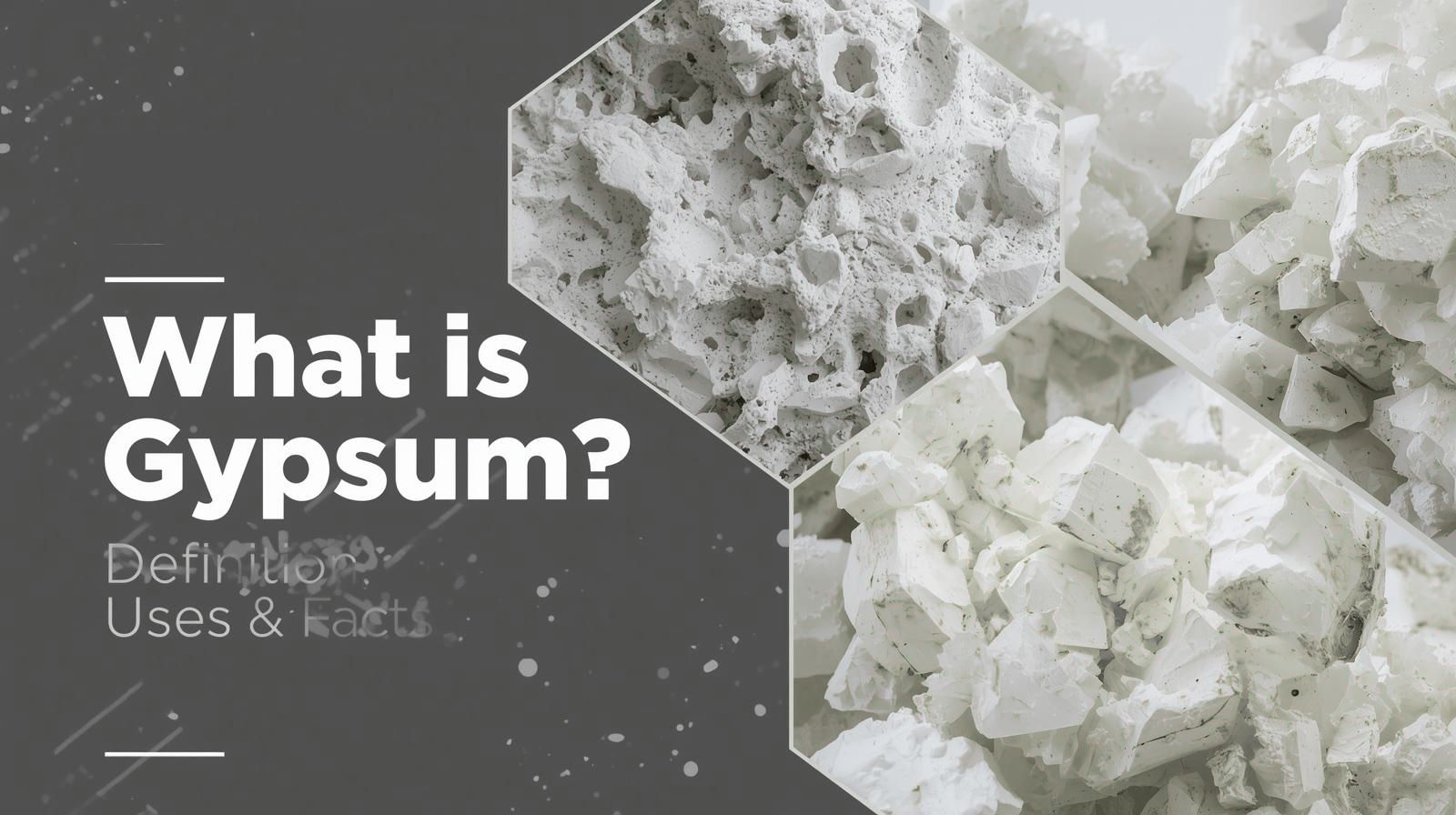
What is Gypsum? Definition, Uses, & Facts
Gypsum is one of the most widely used minerals in the world but many people outside construction and agriculture don’t know much about it. If you’ve seen white powdery walls, smooth ceilings, or even certain fertilizers, you’ve likely come across gypsum.
In this blog, we’ll break down what is gypsum, how it’s formed, what gypsum is used for, and why it’s essential in modern industries like construction and agriculture.
What is Gypsum?
Gypsum is a naturally occurring mineral made of calcium sulfate dihydrate (CaSO₄·2H₂O). It looks like a white or gray soft rock and can also appear as transparent crystals.
In simpler terms:
- It’s a soft, chalky material.
- It contains water in its natural form.
- When heated, it loses water and becomes plaster of Paris.
Quick Facts:
- Chemical name: Calcium Sulfate Dihydrate
- Hardness: 2 on the Mohs scale (very soft; can be scratched with a fingernail)
- Color: White, grey, yellowish, or colorless
- Solubility: Slightly soluble in water
- Natural form: Found in sedimentary rock layers and as evaporite minerals in lake beds
Where Does Gypsum Come From?
Gypsum forms when seawater evaporates in massive prehistoric basins, leaving behind calcium and sulfate deposits. These layers harden over time into large sedimentary beds.
Countries like the USA, China, Iran, and India have large gypsum reserves. It’s also produced synthetically in factories, especially from industrial waste like flue gas desulfurization in power plants.
What is Gypsum Used For?
Gypsum is incredibly versatile. It finds use in everything from construction to medicine. Below are the most common applications:
1. Gypsum in Construction
This is where gypsum really shines. It’s a vital building material because of its fire resistance, sound insulation, and smooth finishing.
Popular uses in construction include:
- Gypsum boards (Drywall): Used for interior walls and ceilings.
- Plaster of Paris: Created by heating gypsum to 150°C; used for molding and surface finishing.
- False ceilings: Lightweight and aesthetically pleasing.
- Partition walls: Provides insulation and ease of installation.
- Flooring compound: Adds strength and durability.
Fun Fact: Almost all modern homes use gypsum board (drywall) in some form!
2. Agriculture and Soil Treatment
Farmers use gypsum as a soil amendment to improve structure and drainage. It also helps reduce aluminum toxicity in acidic soils and adds vital nutrients like calcium and sulfur.
Key benefits in agriculture:
- Breaks up compacted soil (especially clay)
- Improves water infiltration
- Reduces soil erosion
- Enhances root development
3. Cement Production
Gypsum is mixed with clinker during cement manufacturing to control setting time. Without it, cement would harden too quickly during application.
4. Medical and Dental Applications
Dentists use dental plaster, a refined form of gypsum, to make molds for teeth. It’s also used in orthopedic casts to immobilize broken bones.
5. Sculptures and Decorative Items
Plaster of Paris derived from gypsum is widely used for creating artistic sculptures, decorative moldings, and even Ganesha idols in India.
Why is Gypsum Good?
Gypsum stands out for a few key reasons:
- Fire-resistant (used in drywall for safety)
- Abundant and low-cost
- Easy to work with and shape
- Supports sustainable construction
Thanks to these qualities, gypsum plays a role in safer, faster, and more efficient construction methods worldwide.
Types of Gypsum Products
Here are common gypsum-based products you might have heard of:
| Product Type | Common Use |
| Gypsum Board (Drywall) | Interior walls, ceilings |
| Plaster of Paris | Molding, sculpting, patching walls |
| Gypsum Plaster | Smooth wall finishes (alternative to cement) |
| Agricultural Gypsum | Soil improvement and fertilizer component |
| Dental Plaster | Dental molds and impressions |
Is Gypsum Environmentally Friendly?
Yes! Gypsum is considered an eco-friendly material. Here’s why:
- Recyclable: Gypsum board can be reused or reprocessed.
- Energy-efficient: Requires less energy to produce than cement or concrete.
- Low VOCs: Emits fewer volatile organic compounds.
Moreover, the use of synthetic gypsum from industrial waste helps reduce landfill usage and promote sustainability.
When Gypsum Can Be a Problem
Gypsum can become a health concern only under these conditions:
- Poor ventilation during installation
- No masks or dust control during cutting/sanding
- Continuous exposure in industrial settings
- Improper disposal or breaking of boards indoors
This is no different from cement dust, wood dust, or silica dust, all of which are more harmful than gypsum.
Safety Measures (Industry Standard)
To address health risks, professionals follow simple controls:
- Wear dust masks or respirators during cutting/sanding
- Use dust-free cutting tools
- Ensure proper ventilation
- Clean dust immediately after installation
- Seal surfaces with paint or finishing layers
When these are followed, gypsum is safe for partition walls and ceilings.
Conclusion
So, what is gypsum? It’s more than just a chalky white rock it’s a crucial ingredient in our walls, ceilings, soil, and even healthcare products. With its wide range of applications and eco-friendly profile, gypsum continues to shape modern living in quiet but powerful ways.
Whether you’re a homeowner, builder, farmer, or simply curious, understanding what gypsum is used for helps appreciate how this humble mineral supports our daily life.


Make An Enquiry1
customers says
KMG is a great builder to work with. Biggest advantages that I got by selecting KMG villa project : – Affordable – In time completion. Hats off for keeping the promise on timelines. All the best to the Team for future endeavors.

Ali Mubarack
Business
Thank you,Pleasantly surprised and extremely pleased…that is how we would describe our building experience with KMG. From start to finish, everyone was very professional and helpful.

Madhavan Nair
Ex Army Engineer
We recommend KMG developer as perfect home makers and we have decided to go for a KMG Villa too in another couple of years. Wish you the best for for all upcoming projects.
